Thursday, January 28, 2016

The Long Journey


How One Book Became an Epic Series: Part I

Nearly thirty years ago, I started writing a fantasy novel. My first version was about two hundred typed pages and I was convinced I'd created a good story.  I packed it up in an envelope and sent it off to a few publishers. Back then, that was the only option for getting a book out.

Now, I'd written it originally on steno pads by hand. Then I'd laboriously typed it up on an electric typewriter as computers were still in their infancy. Somewhere along the way, I did get some of it typed an printed on an IBM mainframe computer at school where I worked. The copy was a dot matrix version on rolls of computer paper. (Only you older readers will know what I mean, I fear.)

My queries to publishers didn't get very far and I still have several vanilla rejection letters lying around. They were form letters with nothing in them to encourage me.

I have a friend who is a professionally published writer and I showed him my manuscript. He liked the story and suggested it needed a rewrite. Soon, we were meeting several times a month, fleshing out characters, descriptions, and action to bring the skeleton of a tale I'd written to new life.

Over the next few years, I wrote and re-wrote, developing Kingdom Beyond the Rim into a full fledged epic fantasy of nearly a thousand double spaced typed pages. By then, the personal computer market had exploded and I had a PC and a laser printer at my disposal, so life and editing had taken a much better turn.

Off wen the manuscript in a cardboard box--still no digital submissions at that time--to potential publishers. Caught in the evil circle of:  "You need an agent to submit a book, but you can't get an agent unless you've published,"  the market was limited.  My book would vanish into the abyss of publisher slush piles for months on end, only to return to me without a dog ear or smudge on a single page. At that point, I surrendered. I still felt I had a book worthy of print, but without a way to get it published, things looked bleak.

Over the next few years. I found myself still writing. As a high school English teacher, I was always creating lessons, worksheets, stories, and all kinds of materials for my students. I used my fantasy character and setting to develop a writing site for my classes to use to learn how to write creatively themselves. Always, in some way or another, Jamus, my main character, and the world of Magiskeep just keep on living.

Then, through the pure fun of playing computer adventure games--most notably Sierra's Quest for Glory series, I joined an on-line message board, The Half-Wittenberg Door, and the Saga of Magiskeep was born anew. .

Tuesday, January 5, 2016

The Fall of Heroes

And So It Goes

I don't have a long list of famous people I really adore. I'm not a big fan of any sports heroes, rock stars, or movie stars--at least not to the point of swooning over them.  But I have been let down more than once by famous people I've admired over the years. Suffice it to say, my list is short, but I must admit, it has taught me a lot about human nature. 

Very few humans can quite stay up on the narrow pedestal worshippers create for them. I'm sure we've all been disappointed by people in our own lives, but when a high profile person disappoints us, it can be even more significant. Often, fans invest themselves in the hero, live their own dreams through him or her, and then feel a personal loss, when that hero falls. 

I think one of the reasons I like to write is so I can control the characters and the worlds I create, allowing me to decide who wins and loses. 

But the writing world is not reality. Over these last few years, I've been let down more than once by famous people I had grown to admire. 

Lance Armstrong, the former Tour de France winner is one. I learned to understand and enjoy the Tour by rooting for him. I read his book, respected his story of a long and hard recovery from cancer. I listened to endless praise of how hard he worked to prepare for the race, how he used strategy to win, and how his amazing endurance won time and time again in the torturous climbs in the mountains. He was accused over and over of using performance enhancing drugs and always tested clean. I believed in his talent and athleticism. He made me a fan of the Tour. 

Then the truth came out. Armstrong was stripped of his seven Tour victories because of blood doping. It hurt. I was truly disappointed that someone on my pedestal had fallen so far. 

Tiger Woods was a disappointment of another kind. The world's and my impression of him was taht he was an upstanding gentlemen both on the golf course and off. He was a superstar and I watched gold tournaments just because he was playing. 

Then, he too, fell from grace, proving to be an unfaithful husband. Again, another pedestal had at least partially collapsed. After his personal fall, Woods seemed to have lost the luster on his game as well. I still root for him when he plays and hope he will somehow manage to regain his skill and standing as one of the world's top golfers. But the golfer and man will never be quite the same for me. 

And then, there's Bill Cosby. He was always one of my favorite comedians. I still remember some of his old comedy routines, especially one about a Volkswagen he drove, and cherish the laughter he brought into my life. 

Of all my heroes he has fallen the farthest, mostly because the reason for his fall is so morally reprehensible. He is a villain of the highest degree ruining far more lives than the others. 

Traditions of literature demand the tragic hero must have the tragic flaw which ultimately leads to his/her downfall. Looking at the real world, it's sadly easy to see that tradition holding true as well. 

I think I'll stick to fantasy. At least that way, heroes only fall if I want them to. 

Friday, December 18, 2015

Merry Christmas And All That

Long Time, No See

Sorry I've been neglecting the blog of late. I was so wrapped up in the final editing and formatting of "Blackwing Rising" that it seemed to consume all my author energies.

For some reason, MS Word's quirks managed to make the manuscript translate incorrectly into some of the Epub formats. I lost paragraph indents. It took"forever" to get it all fixed. When a book is over 400 pages long, editing takes hours.

Apparently, when I transferred some of the pages from one version of Word to another, the formatting floated off into one of the black holes Microsoft Office likes to offer now and then. I've fallen into them before and learned how to work my way back out, but sometimes it takes a lot of experimenting. At long last, Smashwords accepted the book for its premium distribution channels, so it's finally available in just about all electronic version.s

Then I headed back over to CreateSpace to publish the paperback version. First I had some cover problems--relatively easy to fix this time.  Bless its little heart, the interior was just fine, but it didn't get there easily. This time it was trying to get the page numbering to work the way I wanted it to. Setting the section breaks kept sending my first chapter off into the black hole of even instead of odd page placement, no matter what I seemed to do. I must have "killed" another couple hours getting that right.

Then, of course, there is the filing for ISBN numbers. I have purchased a block of ISBN's to register for my books. Each book requires three ISBN numbers, one for each kind of publication. So each book has a Kindle number, an electronic text number, and a paperback/print number--well, not really. I could use the same ISBN for Kindle and the other electronic text versions, but I haven't. (I do need to check on this.)  At any rate, I do have to enter a lot of data to get the books registers. (There is a "clone" feature I discovered that helps, however.)

While much of this work is a nuisance, I do find having control over publication is empowering. Of course, I would love to have a publisher take me on, but for now, I am happy to do it myself.

I am now immersed in the coming holidays, so I may not post much again for a while. So, with the spirit of peace, joy, love and hope, I wish you all a Merry Christmas!


Saturday, October 24, 2015

How To Write a Novel

What's Important, After All is Said and Done?

A Facebook friend was stuck with her novel. She had a good main character--a protagonist, a good setting and a basic premise. She'd started to write and then gotten stuck. She just had no idea where to go from there.

Novels and short stories all have something in common. They do need good characters, good settings, and good basic ideas, but the most important element is that they must have a plot.

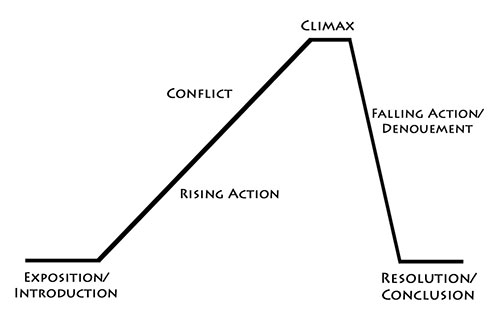
If you ever studied English literature in school, you probably, at some point, ran into that infamous diagram of the structure of a short story. Here's an example:
http://www.englishessaywritingtips.com/2010/12/how-do-i-write-a-short-story-essay/
All the elements are essential to have a real short story. The basic idea here is that in a short story, all the action is directed towards solving a problem of some sort--the conflict. Eventually that leads to the moment in the story where the problem is confronted and solved--the climax. 

So, the problem is introduced in the exposition. There is where the story setting is established, the characters are introduced and the potential problem is introduced as well. Then there is story action that takes place to develop the conflict and define the problem. The action continues to build until the climax. Usually, there are consequences to the solution and finally the story reaches some kind of conclusion. 

Here's a short example. Joe and Jim are students at a small high school. They are both superstar athletes and members of the basketball team. (Exposition)  They both try to outdo each other during games and practice. (Rising Action) This leads to a rivalry as during the games their selfish attempts to get the ball to score starts to undermine the team spirit and success. They both want to be captain and to be the heroes of every game. (Conflict) Despite the two, the team makes it to the championship playoffs. During the game, however, Joe's and Jim's actions start to cause trouble when the other team focuses on guarding them and they start to have trouble scoring. The game goes to the last quarter with Joe's and Jim's team down by two points. (Continued conflict builds as the stakes get higher.) Neither one can get in a shot but then Joe gets in the clear. Jim has the ball and is close to the basket, surrounded by defensive players.  At the last second, Jim passes the ball to Joe who makes a basket from mid-court to score three points to win the game. (Climax)  After the game, Joe is hailed as a the hero for scoring the winning points. (Falling Action)  He is named captain of the team. (Falling Action)  Ultimately, though, Joe declines the honor and tells everyone Jim really deserves the captaincy because he was the one who sacrificed his chance at glory for the team. (Resolution/Conclusion) In turn, Jim insists the two should be co-captains instead. (Conclusion) 

Sure, it's a cliche story, but it illustrates plot structure for a short story. 

Novels are basically short stories expanded. Instead of one line of structure, they often have many. The plot must still be there, with an overall problem that needs to be solved and, indeed, it too much reach a climax through rising action, but the action rises, falls and often reaches a number of smaller climaxes along the way. There are also likely to be several different conflicts going on as the novel progresses. The heroes might well need to overcome dozens of smaller obstacles--essentially finishing little short stories--along the way to solving the large, overriding problem of the main plot line. 

Lord of the Rings illustrates this well as each set of characters in the epic meet and conquer numerous challenges along the road to finally destroying the Ring and freeing the world of Sauron's evil force and returning mankind to peace. There are dozens of crises and conflicts along the way, any one of which could be a short story all its own. 

But here is the crucial difference. As novels, all of the side journeys and quests are linked to the one overriding conflict--ridding the world of the destructive dark magic of Sauron. While each novel in the series does have its own conclusion, all is not resolved until the final pages of The Return of the King. 

Drawing a plot diagram of the novel is an almost impossible task. I once saw a picture of the story board JK Rawling had created for her Harry Potter novels and it easily covered the entire wall of her office.  Conflicts, plot, and character connections abound. Each novel has its own structure and that needed to be carefully linked to the other books. Yet over and over, the essential structure of the story was repeated. 

Create the world. Create your characters. Create a conflict--a problem to be solved. And then, go about solving it.  Create tension for the reader along the way as he wonders whether or not the hero will win over the odds. And then, find that climax when the problem is faced head-on. 

That's all there is to it. I always hope the hero wins. 

Monday, October 19, 2015

Work Ethics: Fantasy and Reality

Every Job Has Its Worth

This is not a political rant, but rather a human one. One of the recurring themes in my Saga of Magiskeep is how most men want to work for something in their lives. In a sense, some of the Magicians in the Saga are "the idle rich" who so depend on their Magic to meet all their needs that they have no need to work for anything. Their lives, because of that, have a certain purposelessness which leads them to seek ways to satisfy their needs.  This often leads to dominating others just for the sake of having "something to do."

Jamus, the hero of the novels, recognizes this need, and respects it in his role as Master of Magiskeep. While Magic might certainly be able to solve every problem with no effort except the lifting of his hand, more often he chooses a more human solution, both out of his own need and out of respect for those around him who lack Magic as an answer.

Although the Saga is a fantasy, its culture is rooted in reality. In this case, the reality that people do want to earn their way in the world. Several real world examples reminded me of this reality lately.

One was an encounter in my doctor's waiting room. A middle-aged woman came in to deliver something and then sat near me to relax for a few minutes. I soon struck up a conversation with her and found out she was a newspaper delivery woman. From what she said, she delivered papers all day long for several different distributors. She told me about a car accident she'd had recently, the problems it had caused with her truck, and of the financial issues she was facing.

Paper Boy Clip ArtI'm sure her job does not pay well--most likely minimum wage--and I suspect most people would think that it also requires very little skill. Driving, following a specified route, and tossing papers out the window certainly doesn't seem very high tech to most of us. But as I talked to this woman, I realized there was much more to it.  She explained, with certain pride, how she had mastered the technique of throwing the papers so they would hit people's driveways. "Papers today are much lighter than they used to be," she said. "You have to throw them flat instead of up in the air so they land where you want them to. I've figured out just how to throw them so they almost always hit the driveway where I want them to"

Clearly, her job was something special, both to her and to the customers she served. I know she worked hard every day with long routes and long hours. Then, as an even better revelation, I found out that she was the person who delivered a local free paper to my house. I told her I was delighted to get the paper, but apparently whoever was delivering it thought my two driveways were for separate houses, so I was getting two papers each week. Immediately, she asked me where my house was. I gave her my address and told her the driveway with the mailbox was the best one for the paper.

Sure enough, the next week, and every week since, I have been getting only one paper, delivered by special throw, right by my mailbox.

Talk about pride and a job well done.

More in the next blog.

Tuesday, October 13, 2015

Writing for Contests 2

So, Who Wins?
Obey The Rules Badge Clip Art

If you read my last post, you viewed a contest from the inside out, looking at the entrants from a judge's position.  Clearly, there are some lessons to be learned.

First and foremost, you must plan and complete your entry according to the directions. In the case of the essays, there was a 700-1000 word limit and essays were to be submitted as either MS Word documents or PDF files. There was a deadline for submission as well.

Some contests will be even more specific Perhaps an entry must be double spaced, paginated, with the document name on each page. Your identity information needs to be submitted somewhere. Is is a separate page, on an entry form, on each page? How long should your entry be? All the details for submission are important.

I recently entered a contest where my manuscript actually received scoring points based on whether or not I followed all the rules. The rules are there for a reason. Read them carefully and follow them to the letter.

Then, of course, make sure your entry meets the other requirements. If you are answering a question or posing a problem solution, as the students were, make sure you read the topic carefully and then address all parts of the questions posed.  If you are required to submit a short story, make sure what you've written really is a short story. Know the literary format you are offering and write an piece that suits the demands.

Clean copy matters. Check and recheck for spelling errors. Proofread and, if you can, have someone else proofread your copy. Spelling counts, and so does grammar. Don't depend on MS Words grammar/spellchecker or even such programs as Grammarly. I've used both and neither one picks up all the errors. They are good starts, but in the end, a good human editor does the best job.

An outside reader is always an asset. Quite often when we write, we think we are saying one thing when, in reality, our words are saying something quite different. When my students in class used to complain about how I graded a paper when their words just didn't make sense, they would say, "Well, you know what I meant."  I may have known, but my reply was, "I only know what you wrote."

As far as content goes, there isn't much advice I can give beyond, "Be true to your voice."  Avoid the cliche' and cherish your own original ideas. Don't try to copy someone else's style unless it's part of the contest. ("Write a Story in the Style of William Shakespeare") If you win, and the world expects more writing from you, then you will be expected to be able to write with the same quality and style again, so the more "you" the writing is the better. There's no reason to pretend you are someone or something else than you honestly are.

I think, especially for beginning writers, this is often a real challenge. Finding your "voice" is not always easy. That's one reason I usually read what I write aloud. Often, when I hear myself saying the words I discover what works and what doesn't. "Tell me a story. Write what you would say."  Flowery word and phrases don't score points unless they are essential to the story.  Don't be afraid to experiment with words, but use them wisely and well.

Will you win? That all depends on the judge, and, as you saw from my last post, a portion of judging is always subjective. Losing is never easy, but remember, there's always another contest, another judge and another opportunity. Just keep on writing.

Monday, October 12, 2015

Writing for Contests

And I'm The Judge

If you've ever entered a writing contest and not won, perhaps it's time to hear from the judge.

Recently, I was asked to judge a contest with essay written by high school students. The topic was: "A Solution to Conflict Resolution in Your High School."  The background information suggested that because of diverse culture groups in schools, there was often conflict among students with different beliefs and backgrounds. Contestants were asked to discuss the problem and then pose a program to adopt in their schools to resolved these issues.

There were a dozen essays submitted. Even though they were digitally submitted, I ended up printing them out as it was much easier for me to judge them on paper. (The teacher in me has old habits that die hard.)

My first read-through separated the top essays pretty quickly. How?  Grammar, spelling, and construction mistakes were a top priority.  One student, for example, wrote and entire two page essay as one paragraph. Another had repeated spelling errors. Another had sentences that simply did not make any sense.
One essay, impeccably written, only focused on analyzing the problem of conflict and its causes, never once proposing a solution or school program. Of all, that was the most disappointing, as the student missed the entire purpose of the essay.

Several of the essays I eventually rejected as top placers suggested similar solutions of assembly programs and rather ordinary solutions.  What I was hoping to see were some original and creative ideas.

Ultimately, I ended up with four essays in the top tier. All were extremely well-written, and all had fresh new ideas.  At that point, the judging came down to deciding just which ideas were the best of the best.  I finally decided on a Fantasy Friend program which set up a plan to pair students of different ethnic/social backgrounds based on mutual interests and a proposal for a Food Festival where students would share cultures through sharing ethic dishes. Of the group, these were the two most innovative and well-described projects.

It was not easy to decide from the essays presented. Surprisingly, the two winners were freshman students.  One older student wrote an impressive essay full of high level vocabulary that simply did not communicate its ideas well. Another simply proposed bringing in speakers from outside the school to present formal talks to students--not particularly innovative. So, in this case, the younger students had the edge in both innovation and communication.

All the essays were eventually published in a booklet presented at the awards ceremony.  I was unable to attend due to my recent surgery, but I did put a statement in the booklet, commending each contestant and charging students to put their words into practice by working to establish their programs in their own schools. "Words to have great power. Converted into action, they can change the world."

My only concern is that I found out later that one of the people who helped with the booklet had proofread the essays and made some corrections. This was not a happy discovery. As I noted before, some of the essays were judged lower because of grammar and spelling errors. If those were "cleaned up" for publication, then others reading the essays might well question my judgment in scoring them.

I stand by my decisions, as any judge must. Overall, it was a wonderful experience to read the essays and see so much good writing from our students. I wish them all well, and hope they do find a way to put those ideas into action.

Hands Shake Clip Art